Showing posts with label earthquakes. Show all posts

Tuesday, March 22, 2011

Advanced economies at advantage in disaster recovery


A man sits surrounded by rubble after a magnitude 8.9 earthquake and tsunami in Rikuzentakata, northern Japan March 13, 2011.

The earthquake that devastated northeast Japan displaced the country's main island by 2.4 metres and even tilted the axis of the Earth by nearly 10 centimetres. The shock sounds awesome but it was imperceptible. History suggests the same will be true of the economic impact.
The instinctive reaction when viewing the extensive damage and frantic efforts to secure damaged nuclear reactors is to assume economic havoc will follow.
But researchers who have studied similar disasters in rich countries reach a reassuring conclusion: human resilience and resourcefulness, allied to an ability to draw down accumulated wealth, enable economies to rebound quickly from what seem at first to be unbearable inflictions - be it the Sept. 11, 2001, attacks on New York or Friday's 8.9-magnitude earthquake, the worst in Japan's history.
Japan itself provides Exhibit No. 1 in foretelling the arc of recovery. A 6.8-magnitude temblor struck the western city of Kobe on Jan. 17, 1995, killing 6,400 people and causing damage estimated at 10 trillion yen, or 2 percent of Japan's gross domestic product.
The importance of Kobe's container port, then the world's sixth-largest, and the city's location between Osaka and western Japan made it more significant for the economy than the more sparsely populated region where the latest quake and tsunami struck. Extensive disruption ensued, yet Japan's industrial production, after falling 2.6 percent in January 1995, rose 2.2 percent that February and another 1.0 percent in March. GDP for the whole of the first quarter of 1995 rose at an annualised rate of 3.4 percent.
"Despite the scale of the disaster, it is hard to find much evidence in the macroeconomic data of the effects of the Kobe earthquake," said Richard Jerram, chief Asian economist at Macquarie in Singapore and a veteran Japan-watcher.
Indeed, Takuji Okubo, chief Japan economist at Societe Generale in Tokyo, noted that Japan's economy grew by 1.9 percent in 1995 and 2.6 percent in 1996, above the country's trend growth rate at the time of 1.5 percent. Private consumption, government spending and, especially, public fixed investment all grew above average in 1995 and 1996, Okubo said in a report. By analogy, the medium-term impact on growth from the latest quake was also likely to be positive, he said.
Today's circumstances are, of course, different. Japan's economy has floundered in the intervening 16 years and its public finances have deteriorated. On paper, the country, is perhaps less well prepared at this stage of the economic cycle to pick itself up off its feet.
But Mark Skidmore, an economics professor at Michigan State University, attaches greater importance to a rich society's capacity to constantly adapt to the risks it faces. In the case of Japan, prone to regular earthquakes, this means improving its disaster response systems and adopting the latest techniques to help buildings withstand shocks.
Most of the damage wrought in Japan was by the ensuing tsunami, for which there was no time to prepare, and not by collapsing buildings - even though the quake was 1,000 times more powerful than the Kobe one.
"We don't know yet how devastating this is going to be economically, or even in terms of human casualties, but Kobe was able to rebound very quickly and I think there is the same potential here," Skidmore said in a telephone interview.
Skidmore and Hideki Toya from Nagoya City University in Japan have examined data for 151 countries over the period 1960-2003 and found that countries with higher levels of income, education and financial development suffer fewer losses from a natural disaster. Other researchers have reached similar conclusions.
"As incomes rise in a society, you can devote more resources to safety. So economies that have relatively high exposure to earthquakes or hurricanes start taking the precautions they need. Japan is among the best prepared in the world because they have high exposure and high income," Skidmore said.

Monday, March 21, 2011

Flooding at home not polar bears convinces people of man made climate change


Nick Pidgeon, Professor of Environmental Psychology at Cardiff University, showed for the first time that people with a direct experience of flooding are more likely to believe in man made climate change.
He said “scare” tactics, such as warning people of floods in Bangladesh or desertification in Sudan, are less likely to motivate people to take action.
“Polar bear images and melting glaciers do raise people's concern but they feel disempowered because they cannot do anything about it, whereas the local thing they understand,” he said.
The survey of 2,000 people in Britain, published in Nature, also found victims of floods are more willing to change their lifestyles to tackle global warming. For example by reducing energy use and taking less long haul flights.
Prof Pidgeon said people are becoming immune to the extreme risks of climate change in the Arctic and Amazon but they are likely to engage on the real risks of flooding and drought at home.
He also said people are more likely to act if they are given positive messages about what they can do.
“All the evidence shows you should be measured in showing people the risk but you can also be clear about the actions they can take. Scaring them will just put them off,” he added.
A separate study by the Carbon Trust found that more than half of people in Britain want big business to be more responsible when it comes to cutting greenhouse gas emissions.
However just seven per cent believe public announcements from a company about how it is reducing its impact on climate change are accurate
This week a number of initiatives to cut carbon are being held around the country for Climate Week, a nationwide event sponsored by Tesco and supported by Al Gore and Sir Paul McCartney.
The idea is to celebrate the positive things people can do to cut carbon emissions such as saving energy at home and taking public transport.
However campaigners say that some of the companies involved have failed to do enough to tackle climate change.
The World Development Movement claim that one of the main sponsors, the Royal Bank of Scotland, has invested more in coal-fired power stations than any other UK bank over the last few years.


Monday, March 14, 2011

Global warming may bring tsunami and quakes: scientists


- Quakes, volcanic eruptions, giant landslides and tsunamis may become more frequent as global warming changes the earth's crust, scientists said on Wednesday.

Climate-linked geological changes may also trigger "methane burps," the release of a potent greenhouse gas, currently stored in solid form under melting permafrost and the seabed, in quantities greater than all the carbon dioxide (CO2) in our air today.

"Climate change doesn't just affect the atmosphere and the oceans but the earth's crust as well. The whole earth is an interactive system," Professor Bill McGuire of University College London told Reuters, at the first major conference of scientists researching the changing climate's effects on geological hazards.

"In the political community people are almost completely unaware of any geological aspects to climate change."

The vulcanologists, seismologists, glaciologists, climatologists and landslide experts at the meeting have looked to the past to try to predict future changes, particularly to climate upheaval at the end of the last ice age, some 12,000 years ago.

"When the ice is lost, the earth's crust bounces back up again and that triggers earthquakes, which trigger submarine landslides, which cause tsunamis," said McGuire, who organized the three-day conference.

David Pyle of Oxford University said small changes in the mass of the earth's surface seems to affect volcanic activity in general, not just in places where ice receded after a cold spell. Weather patterns also seem to affect volcanic activity - not just the other way round, he told the conference.

LONDON'S ASIAN SUNSET

Behind him was a slide of a dazzlingly bright orange painting, "London sunset after Krakatau, 1883" - referring to a huge Asian volcanic eruption whose effects were seen and felt around the world.

Volcanoes can spew vast amounts of ash, sulphur, carbon dioxide and water into the upper atmosphere, reflecting sunlight and sometimes cooling the earth for a couple of years. But too many eruptions, too close together, may have the opposite effect and quicken global warming, said U.S. vulcanologist Peter Ward.

"Prior to man, the most abrupt climate change was initiated by volcanoes, but now man has taken over. Understanding why and how volcanoes did it will help man figure out what to do," he said.

Speakers were careful to point out that many findings still amounted only to hypotheses, but said evidence appeared to be mounting that the world could be in for shocks on a vast scale.

Tony Song of NASA's Jet Propulsion Laboratory in California warned of the vast power of recently discovered "glacial earthquakes" -- in which glacial ice mass crashes downwards like an enormous landslide.

In the West Antarctic, ice piled more than one mile above sea level is being undermined in places by water seeping in underneath.

"Our experiments show that glacial earthquakes can generate far more powerful tsunamis than undersea earthquakes with similar magnitude," said Song.


"Several high-latitude regions, such as Chile, New Zealand and Canadian Newfoundland are particularly at risk."
He said ice sheets appeared to be disintegrating much more rapidly than thought and said glacial earthquake tsunamis were "low-probability but high-risk."
McGuire said the possible geological hazards were alarming enough, but just one small part of a scary picture if man-made CO2 emissions were not stabilized within around the next five years.
"Added to all the rest of the mayhem and chaos, these things would just be the icing on the cake," he said. "Things would be so bad that the odd tsunami or eruption won't make much difference."

Friday, March 11, 2011

1000 killed in major tsunami after 8.9 Japan quake


A powerful tsunami spawned by the largest earthquake in Japan's recorded history slammed the eastern coast on Friday, sweeping away boats, cars, homes and people as widespread fires burned out of control. Authorities said at least 1000 people were killed. The magnitude 8.9 offshore quake was followedby at least 19 aftershocks, most of them of more than magnitude 6.0. Dozens of cities and villages along a 1,300-mile (2,100-kilometer) stretch of coastline were shaken by violent tremors that reached as far away as Tokyo, hundreds of miles (kilometers) from the epicenter. A utility company in northeastern Japan reported a fire in a turbine building of nuclear power plant. A tsunami warning was issued for the entire Pacific, including areas as far away as South America, the entire U.S. West Coast, Canada and Alaska. Japan's Fire and Disaster Management Agency said at least 1000 people were killed.
"The earthquake has caused major damage in broad areas in northern Japan," Prime Minister Naoto Kan said at a news conference.
Even for a country used to earthquakes, this one was of horrific proportions. It unleashed a 23-foot (7-meter) tsunami that swept boats, cars, buildings and tons of debris miles inland. Large fishing boats and other sea vessels rode high waves into the cities, slamming against overpasses. Upturned and partially submerged vehicles were seen bobbing in the water. Waves of muddy waters swept over farmland near the city of Sendai, carrying buildings, some on fire, inland as cars attempted to drive away. Sendai airport, north of Tokyo, was inundated with cars, trucks, buses and thick mud deposited over its runways. Fires spread through a section of the city, public broadcaster NHK reported.
The tsunami roared over embankments, washing cars, houses and farm equipment inland before reversing directions and carrying them out to sea. Flames shot from some of the houses, probably because of burst gas pipes.
"Our initial assessment indicates that there has already been enormous damage," Chief government spokesman Yukio Edano said. "We will make maximum relief effort based on that assessment."

Monday, December 6, 2010

Why Do Earthquakes Happen?

Why Do Earthquakes Happen?
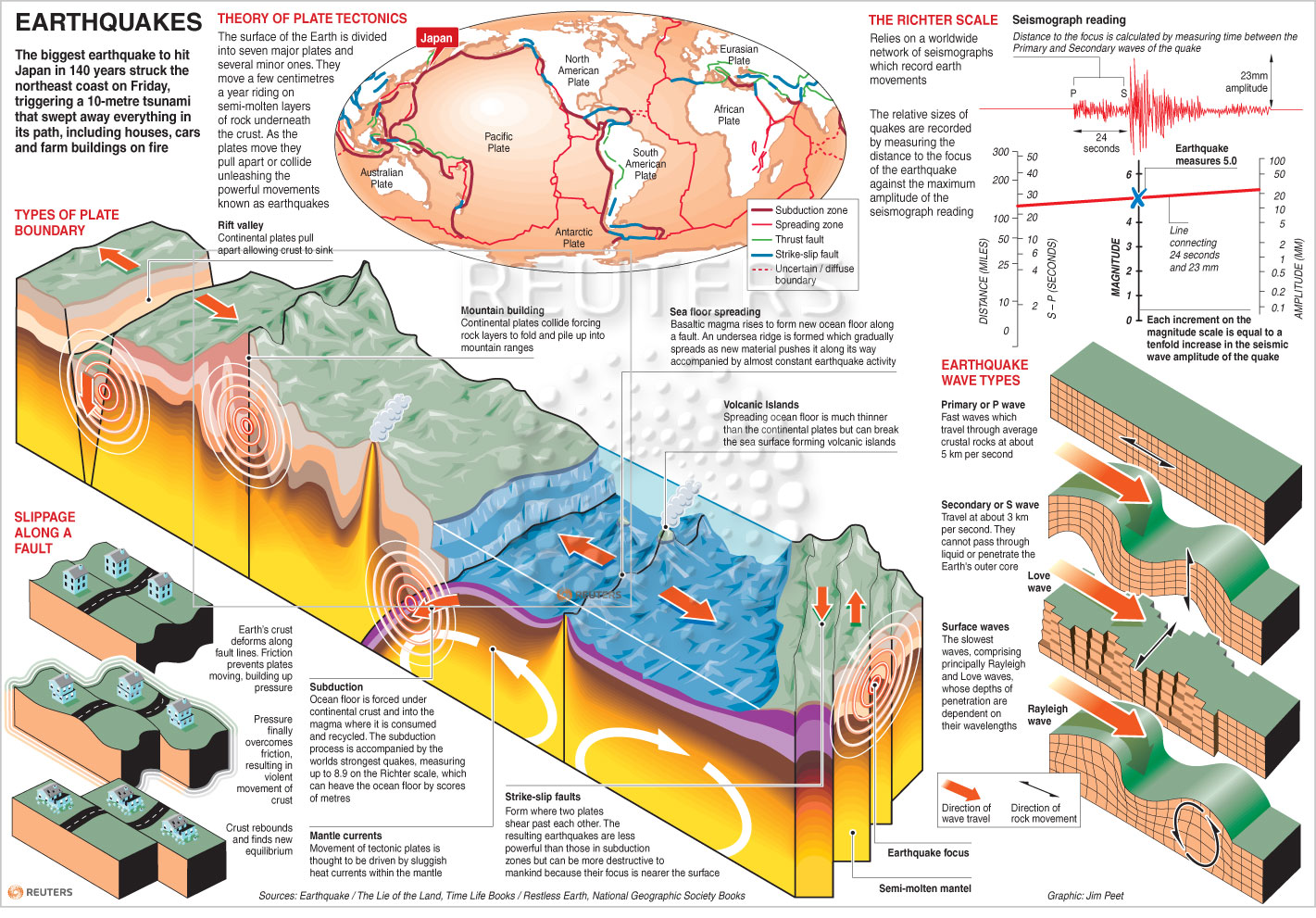
Earthquakes are usually caused when rock underground suddenly breaks along a fault. This sudden release of energy causes the seismic waves that make the ground shake. When two blocks of rock or two plates are rubbing against each other, they stick a little. They don't just slide smoothly; the rocks catch on each other. The rocks are still pushing against each other, but not moving. After a while, the rocks break because of all the pressure that's built up. When the rocks break, the earthquake occurs. During the earthquake and afterward, the plates or blocks of rock start moving, and they continue to move until they get stuck again. The spot underground where the rock breaks is called the focus of the earthquake. The place right above the focus (on top of the ground) is called the epicenter of the earthquake.
Try this little experiment:
  1. Break a block of foam rubber in half.
  2. Put the pieces on a smooth table.
  3. Put the rough edges of the foam rubber pieces together.
  4. While pushing the two pieces together lightly, push one piece away from you along the table top while pulling the other piece toward you. See how they stick?
  5. Keep pushing and pulling smoothly.

    Soon a little bit of foam rubber along the crack (the fault) will break and the two pieces will suddenly slip past each other. That sudden breaking of the foam rubber is the earthquake. That's just what happens along a strike-slip fault.
Earthquake-like seismic waves can also be caused by explosions underground. These explosions may be set off to break rock while making tunnels for roads, railroads, subways, or mines. These explosions, however, don't cause very strong seismic waves. You may not even feel them. Sometimes seismic waves occur when the roof or walls of a mine collapse. These can sometimes be felt by people near the mine. The largest underground explosions, from tests of nuclear warheads (bombs), can create seismic waves very much like large earthquakes. This fact has been exploited as a means to enforce the global nuclear test ban, because no nuclear warhead can be detonated on earth without producing such seismic waves.